Showing posts with label JSS 3 Notes. Show all posts

Sunday, 9 March 2014

JSS 3.TOPIC 11: RURAL AND URBAN WATER SUPPLY

FOR MORE DETAILED NOTES AND VIDEOS...


Sources of Water.
Rainfall is the main source of water to man. Water source can either be surface or underground source eg

Surface Sources: Surface water include the following
 (i). Rain water collected directly from roofs
(ii). Water from rivers, ponds and lakes
(iii). Run – off from natural catchments into natural or artificial lakes.
Surface sources of water usually contain micro-organisms. As such, water from these sources must be treated before drinking.

Underground Sources: Underground sources of water include:
Wells- both shallow wells and deep wells’
Shallow wells are mostly used in the rural areas. They are fed by rainfall on the surrounding ground which may carry polluting matters from the surface. Lining such wells provides a lot of security and safety to the consumers.

Water levels underground.


Deep wells: These wells derive their water from below the impermeable stratum. The water here is relatively safe having being filtered on its way downwards.

Springs: Spring water is water that has travelled through the ground and come to the surface as a result of geological conditions. The water flows over an impermeable stratum onto the ground surface.     

Water Quality
Drinking water must not only be safe and free from dangers to health, it must also be of good chemical and physical quality so as to be acceptable to the people. NAFDAC is supposed to ensure the quality of water consumed nationwide.

Rural Water Supply System
Well, using rope and bucket’
Well, equipped with a windlass
Well, with hand pump and motorized pump. The hand pump is the reciprocating pump or the type used in selling kerosene.

                                      Urban Water Supply System
 In order to meet the constant demand for water supply in towns and cities the water supply scheme embarked on generally comprises of the following.

Collection or Intake system (Dam): In this system, a pump house is usually located close to a dam, while purification takes place at the treatment plant. The treated water is pumped through large diameter pipes to reservoirs located at suitable sites for distribution. These elevated reservoirs supply by gravity. But because of distance some booster pumps are used to boost supply pressure so that water can reach all supply outlets.

Purification System: Before city water supply system is distributed, the purification must take place first. This involves he following
Aeration- to remove dissolved gases.
Clarification- to get rid of suspended materials so that the water becomes clear.
Filtration- to remove particulate matters.
Disinfection- using chlorine to destroy undesirable organisms in water to control odour and eliminate hydrogen sulphide in water.

Transmission and Distribution System: The transmission system consists of pipelines that conveys water from he treatment plant to the reservoir.
The distribution system is another complex network of pipelines to distribute water from the reservoir to city houses, offices and fire hydrants. The pipes are usually buried at least 30cm below the ground.
The distribution reservoir is required to store excess water during the periods of peak demands. They must be placed at higher elevation so as to supply by gravity.

Learn More


Wednesday, 26 February 2014

JSS 3. TOPIC 10: AIR-MECHANICAL PROPERTIES.

With air all around us, it can be harnessed for the development of technological tools and air transportation. Air content of gases, mainly nitrogen and oxygen eg

                                                           Mechanical properties of air
The mechanical properties of air weight, atmospheric pressure and the relationship between pressure, temperature and speed.

Weight: For the fact that we cannot see air it does not mean that air does not have weight. That air weighs something can be experimented with an empty balloon. If filled with air, the balloons original weight increases.

Atmospheric Pressure: This is the same thing as air pressure. This pressure is defined as the force per unit area, written mathematically as P = F/A. eg siphoning, vacuum pump, vapour pressure (tumbler filled with water) etc. the instrument used in measuring air pressure is called barometer.

Relationship Between Air Pressure and Speed: It has been proven that air flow is generated as a result of difference in pressure. For instance, breeze, wind, hurricane etc can  move objects, depending the direction of flow.

When air flows it produces several effects such lift, drag, sound etc. this results because air pressure increases with the speed of flow. However, it should be noted that air pressure increases twice as speed.ie while speed may be 2kph,  air pressure is already 4kph.
No wonder air pressure us applied to the flying of kites, p1ropelling of airplanes and operation of wind mills etc.

                                                       Effects of air flow on Aerofoil
Streamlined – shaped objects are called airfoils, eg kites, birds, airplanes, rockets etc. Usually streams of air travel longer distance above the surface of the aerofoil because of its shape than the surface below. Thus, air travels faster above than below. The faster air travels, the less the sideways pressure it exerts. For this reason, low pressure is developed at the top of the face of the aerofoil than below.
It is by this principle that airfoils experience a lift, and that’s why airplanes gain weight in the air. eg

                                                           Extremes of Air flow
There are two extremes of air flow, namely:

Laminar air flow: This is slow speed flow of air flow. It is also called streamline flow.


 Turbulent flow: This is the high speed flow of air. Sometimes it is a forced air. Eg see diagram above.

                                                    Pneumatics and Hydraulic Devices
Pneumatics is a device that makes use of compressed air to do useful work. Such devices make use of cylinders to produce force or linear motion at changing speeds. Generally, both pneumatics and hydraulic devices are used for the following purposes.
For pushing
For pulling and
For lifting
                                                                    Pneumatic Devices
Hand Pump: These are of different types, they are used to inflate tyres, balloons, balls etc. the hand pump has a plunger which sucks in and pushes out air at the barrel cylinder.


Compressor Machine: This is used by vulcanizers, while the modified one is used as a spray machine on several products.


 Hydraulic: These are devices that make use of liquids to push, pull and lift materials.

                                                                      Hydraulic Devices
Hydraulic Jack: This jack has two main parts – the handle and the lever which is connected by two pistons which raises the lever that raises the load (car).
Suction and Double acting pumps: These are locally manually operated pumps used for lifting liquids and gases from reservoirs. e.g.


  Garden Sprinkler: The sprinkler is used in water gardens. It has jets which issues out water at a given speed about an axis.e.g.

Water Wheel: This wheel can be used to create mechanical energy in grinding, milling and electric power machines.


Others: (a) Reaction turbine (at dams) and (b) Brakes – used in cars to control motion.

Class Work.
What are pneumatics?
What is hydraulic?
Name 2 devices that use pneumatics
Name 4 devices that make use of hydraulic
Assignment:
Using the sketches shown on your text book sketch the following
Hand pump
Suction and double acting pump
Garden sprinkler

JSS 3. TOPIC 9: FLOORS AND ROOFS.

Floor may be defined as a continuous horizontal platform constructed between walls to support any load- both human and materials.
                                                            Types of Floors
There are basically three types of floors, namely:
(i). Solid(basement) Floors: This is a type of floor that consists of concrete but may be finished with a smooth surface like cement screed, laid with tiles or terrazo. Eg.


(ii).Suspended Floors: This is a kind of floor that consists of wood, which are nailed over solid lengths of timber. The ends  are usually supported by the main walls of the building. The solid timber that supports this type of floor a re known as joists. Eg.


(iii). Upper Reinforced Floors: These are solid floors containing reinforcements like sand, concrete, cement, water, and steel. These are the type of floors used in decking storey buildings.


Floor may be defined as a continuous horizontal platform constructed between walls to support any load- both human and materials.


                                                          Roofs
Roof is defined as a covering over buildings that may serve the following purposes:
 (i). protect the occupants from any harsh weather;
(ii). beautify a building;
(iii). to secure buildings.
                                                          Materials used for making Roof
(i). Clay tiles (ceramics).
(ii). Corrugated iron sheets.
(iii). Asbestos sheets
(iv). Aluminum span sheets
(v). Plastic sheets (usually for light)
(vi). Palm fronds.


                                               Types of Roofs
(i). Shed roof or Lean-to roof: These are small-sized roofs used for kiosks, shops and boys quarters. Some are  constructed resting on walls, hence they are referred to as lean-to. Eg.

(ii). Gable or Collar roof: This is a type of roof that contains two sloping faces with the walls rising into the r oof at two opposite ends. It is the commonest type of roof in Nigeria. Eg.

(iii).Hipped roof: This type of roof slopes down all four sides. The walls also rises into the roof on all four sides. This roof is steeper than the gable roofs. Eg.

(iv). Butterfly roof: This type of roof is used for buildings with large spans. It is sometimes called double shed ro9of, since it looks almost like one, but only bigger.eg.

(v). Combination roof: These are asymmetrical roofs used for most school buildings where one face slopes steeper than the other. The greater slope covers the rooms while the shorter slope covers the walkway. Eg.

(vi). Monitor roof: This is a type of roof used for factories and warehouses. It usually contains two surfaces at different levels, where light is let into the building.eg.

(vii). Half-monitor roof: This roof looks like the monitor roof. The only difference is that in this  type of roof, one surface is lowered than the other. Openings are fixed where light is also let into the building in this type of roof. Eg.

(viii). Arched roof: This type of roof has a rounded or curved  shape like an arc. It is also used for buildings with large spans, such as for filling stations, warehouses, etc. eg.

(ix). Flat roof: These are roofs made of concrete castings (like slabs). Drainages are provided through plastic pipes from the roof.

(x). Mansard roof: These are roofs that contain double slopes on all four sides. This type of roof is gradually being outdated.  


Examples of Roofs:


Arc Roof.


Class Work.

(i). define a roof.
(ii). list four materials used for making roofs.
(iii). list five types of roofs.


DownLoad Our FREE Materials Here


JSS 3. TOPIC 8:BUILDING CONSTRUCTION-Windows, doors. Types and uses

Definition:
Door can be defined as openings into buildings. They serve the following purposes:
(i). doors provide security against burglary.
(II). it provides a means of access into the building.
(iii). It facilitates ventilation.
(iv). It also admits a measure of light into the building.
                                                                   Types of Doors
Doors are generally classified into two groups, namely exterior and interior doors.
(i). Exterior doors:  These are doors that are put on the outer part of a building. Some are the doors at the entrances of buildings or at the outer part of the kitchen or garage. They are usually stronger.
(ii). Interior doors:  As the name implies, these are the types of doors that are placed inside the building. They include the bathroom door, bedroom doors and kitchen doors.
For these classes of doors mentioned, they may be one of the  following types:

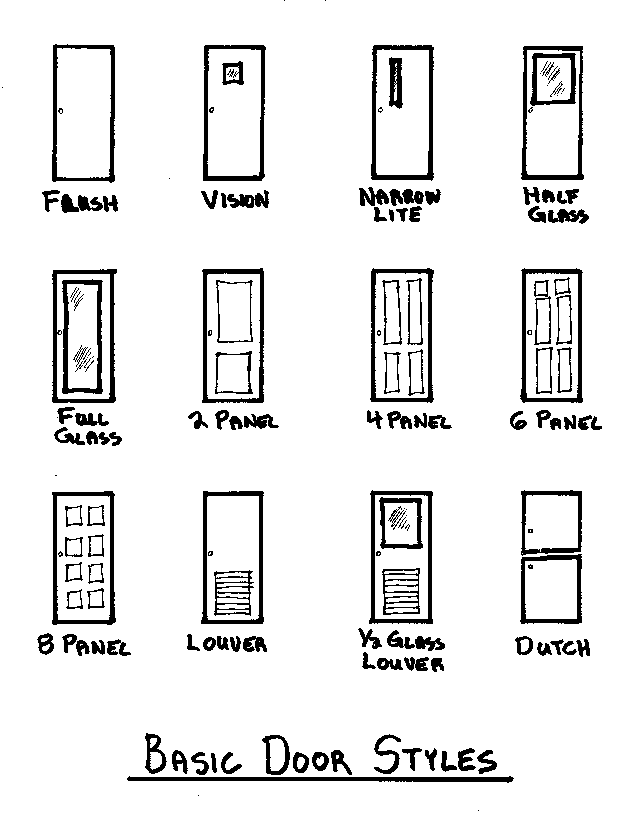
1. Casement door: These doors may be used for both exterior and interior purpose, depending on the taste of the builder. It contains different casement designs. e.g.

2. Louvered door: This is door made of louvers. It is for internal use only.

3. Sliding glass door: These doors are used in offices, shopping  complexes and shops. It slides side ways to allow for passage. It is an exterior door.

4. Flush door: These are internal doors used in toilets, bedrooms and in the kitchen. It is made of flush and plywood.

5. French doors: These are sophisticated, hardened doors, finished with French polish, used for external purpose only.

6. Revolving door: These are doors used in most public buildings like stadia, supermarkets and banks. It is often a glass door.

7. Roller shutter: This is a metal, wide door used in big shops and warehouses or garages. It can be rolled up and down.

8.  Panel door: This door can serve both interior and exterior purpose. The number of panels in this type of door gives it its complete and appropriate name. For instance, some are 5-panelled door, 6 or 7-panelled door.

9. Ledged braced and battened door:  These doors do open both sides at the opening of buildings. They are used on wider openings at garages, shops and stores.

10. Headed doors: These are doors mostly used on worship buildings. They may be semi-circle at the top, tudor, gothic or segmental in shape.


NOTE. To see an image of these types of doors, kindly google them.


                                                                                 Windows.

Windows may be defined as openings in the wall of buildings that serves the following purposes:
(i).allows adequate flow of air into the building (ventilation).
(ii). allows light into the building.
(iii). gives additional beauty to the building.
(iv). It is also a means of viewing the outside world.
Windows are both for interior and exterior purposes.

                                                                    Types of Windows
(i). Casement window: This is a wooden window built just like the casement door.

(ii). Louvered window: As the name implies, this window is made of glass, either transparent or translucent.

(iii).Sliding glass window: This is the most common type of window in Nigeria in recent times. It allows for much ventilation and light, as a part of it can slide sideways.

(iv). Bull’s eye window: This type of window is used for viewing the environment and outside world from a vessel. It is made of a circular  glass.

(v).Dormer window: This is a window attached to a chimney so that smoke can escape from the roof of colonial buildings in the past. It is often made of wood.

(vi). Semi circular or segmental window: These are windows used in religious buildings. The upper part forms an arc. It is usually constructed with wood or glass.
It should be noted that the first three types of windows are commonly used in Nigeria while the other three are special-purpose windows.


Class Work
(i). state 3 purpose of a window in a building.
(ii). list 4 types of windows and their uses.
                                            ASSIGNMENT
Sketch the following types of windows:
Bull’s eye window, dormer window, casement window, sliding door window, louvered window and semi-circular headed window.


DownLoad Our FREE Materials Here


JSS 3. After Mid-Term.TOPIC7: MOTION IN ENGINEERING SYSTEMS.

Definition:
Motion can be defined as the movement of a body (object) from one point to another with the application of force.
                                                                 Types of Motion
At this level, the two types of motion to be considered are Linear Motion and Rotary Motion.
Linear Motion: This is the motion of a body moving in a straight line. For instance, a push-pull link mechanism is a simple machine that operates with linear motion. E.g.


 Rotary Motion: This is motion of a body moving in a circular form. Examples of circular motion is the rotation of a fan, vehicle tyres, the handle of the clock, etc. e.g.


                                                             Transmission of Motion
For any engine to function, motion must be transmitted from one part of the engine to other parts. For instance, in a car, motion is often transmitted from the car engine to the wheels. This is possible because of the motion transmission system in the car.
The transmission system in a car includes the gearbox and the clutch.

Function of the Clutch: The function of the clutch is to disconnect two shafts running at different speeds, that is, the engine crankshaft and the gearbox shaft.


                                                             Types of Car Engines
1.Front- Engine Rear-Wheel Drive: This is an engine that consists of a clutch, a gear box, a propeller shaft and a rear axle. Most cars in Nigeria operate on this type of engine.


2. Front-Engine Front Wheel Drive: In this type of engine, every other parts mentioned in 1 above is present except for the propeller shaft. Transmission is directly from the gearbox to the rotating wheels.


3. Rear-Engine Rear-Wheel Drive: In this type of engine, there is no propeller shaft also. The clutch, engine, gearbox are all engineered at the back of the car. Example is Volkswagen cars.


4. Front-Engine 4-Wheel Drive: This is a more recent technological advancement in the engineering of cars. There is no propeller shaft and most times no mechanical gearbox. The gear system is a hydraulic system. This car contains of the brake and the accelerator only, with all 4 wheels connected to the gear box.
e.g. Mechanical Gear System and Hydraulic Gear System.


                                             Control of Rotary Motion-Brakes
Brakes are meant to bring bicycles and cars in motion to a stop. Kinetic energy in a moving object is absorbed by the brake. This produces heat on the brake as kinetic energy is converted into potential energy. As the brake absorbs heat, the vehicle slows down until it finally comes to a stop.

                                                      How Brakes Work
There are different types of brakes. However, the principle of how the brake works is the use of friction. If the brake in a car or bicycle is pressed against the rotating drum or disc or wheel, the resulting friction between the pad and the drum or wheel slows down the rotating wheels, until they eventually come to a stop. E.g.
A Bicycle Brake.
A Disc Brake.


                                   Conversion of Rotary Motion to Linear Motion
In some machines, it is necessary for a change from one form of motion to another along it’s line of operation. For instance, a sewing machine will need to convert linear motion from the moving pedal to rotary motion at the wheel and finally to linear motion again at the needle.
The piston-crank mechanism of a car engine is another example of converting rotary motion at one point of an engine to rotary motion at another point of the same engine. (teacher will explain more). E.g.

Other examples of machines involved in converting one form of energy to another are;
Screw jack, Rack and piston steering system, Crankshaft and cylinder, Metalwork table vice, Woodworker’s vice, Pipe vice, G-clamp, etc. 

Class Work.
(i) define motion
ii. list the two types of motions
iii. explain how to convert one form of motion to another
iv. explain machines that make use of motions.


DownLoad Our FREE Materials Here


Thursday, 7 November 2013

JSS 3.TOPIC 6: ISOMETRIC DRAWING


Definition: Isometric drawing is defined as a 3-dimensional drawing of an object. It is a pictorial method of drawing. What you see is what you draw to the given scale. The three dimensions are the length, width and height.

Isometric Axis: The term isometric axis means the lines formed by the 300 set square and the vertical line of any given plane or block to be drawn. The lines that slant at 300 are called the receeding lines. The vertical line is also drawn using the side of the 300/600 set square.(your teacher will show you how).
The lines drawn are often referred to as projection lines. Apart from the vertical lines, all other lines are inclined at 300 slant. It is always better to complete the drawing in construction line (faint lines) first, check that everything is correct before outlining the block given.
Steps Involved in Isometric Drawing: Drawing isometric views goes through four main stages. They are:
(i). Drawing of the isometric axis
(ii).Drawing of the given isometric box
(iii).Shaping of the box through outlining of the edges (i.e. making the box drawn thicker).
(iv).Dimensioning.


1. Drawing the Isometric Axis: After setting your paper on your board and drawing border lines and title block, follow the steps below:
i.   On the lower section of your drawing paper mark a small cross(+).
ii.  Using the 300-600 set-square, supported by the T-square, draw the first vertical axis from the intersection of the +.
iii.  Turn the set square to the 300 slant with the edge intersecting at the + either to the right or left and draw the first receeding axis.
iv.  Rotate the set-square until another edge rest as base on the T-square on the same intersection and draw the second receeding axis.(your teacher will demonstrate).

                                                         Drawing Isometric Boxes
To draw the block given in isometric drawing, you can follow the steps below:
i.   Starting on the marked point(+), locate the length, breadth and height with the aid of a pair of compasses and mark these on the already drawn axis.
ii.   With the aid of the 300 slant, starting from the marks made on the axis, draw parallel lines to the previous ones including the vertical axis.
iii.  Draw all parallels to complete any given block. (teacher will demonstrates)
NOTE: Please, note that all the steps explained above must be done in construction (faint) lines using the 2H pencil.


2. Outlining the Edges: Finally, using the HB pencil with moderate pressure, thicken the outline of the given block. You may erase the extra projected lines on your work since they may not be required as part of the given block.

3. Dimensioning: This is the technique of adding the actual size (length, breadth and height) of any block given. The following steps explains how:
(i). With the aid of the set-square and a little distance from the block drawn, draw faint projections (the projection lines should not touch the block) as the block.
(ii). Rotating the set square appropriately, draw arrowhead lines to indicate demarcations on the given block.
Practice Exercises:
1. Using the block sown on page 157 (fig. 7), draw the block in Isometric projection as shown.
2. Draw the block shown on page 158 (fig.11) in isometric projection.
(The teacher demonstrates)

                                                                   ASSIGNMENT

Draw the Isometric blocks shown on pages 156 – 165 of your J.N. Green Technical Drawing Text Book.
(i).Figure 10
(ii).Figure 9
(iii).Figure 8.


Download Our FREE Books and Videos


Monday, 21 October 2013

JSS3, TOPIC 3: Career Prospects and Opportunities in Technology

What is a Career?
 A career can be defined as a profession or job one is trained to do for the rest of his/her life time. Doing this career brings monetary benefits and fulfillment.

Technology Related Careers
Careers related to technology includes the following in Nigeria:
1. Mechanical Engineering
2. Electrical/Electronic Engineering
3. Civil Engineering
4. Building Engineering
5. Production Engineering
6. Chemical Engineering
7. Computer Engineering
8. Automobile Engineering
9. Metallurgical Engineering
10. Mining Engineering
11. Petroleum Engineering
12. Aeronautical Engineering.

                                    Importance of Technology Related careers

1.Mechanical Engineering: The skill and training in this profession has led to the invention of machines used in transportation, manufacturing, plumbing installations, pipe-network construction for gas, water and petroleum products.

2. Building: This is a professional who interprets the plan documents drawn by an architect, into a physical reality.
3. Automobile Engineering: This is a field of engineering that deals with the design, construction and maintenance of automobiles.
4. Aeronautical Engineering: The study that deals with the design, construction and maintenance of aeroplanes is called aeronautical engineering.
5. Production Engineering: This is the field of engineering that deals with how to put different machines together (called assembly lines) used for manufacturing goods like brewing.
6. Metallurgical Engineering: These are professionals that that focus on improving the strength, performance and durability of metals.

                        EMPLOYMENT PROSPECTS FOR TECHNOLOGY STUDENTS

The different areas where students of technology can be gainfully employed in Nigeria include the following:

Private Companies: In Nigeria, there are employment opportunities in most private industries that render services related to engineering. Manufacturing companies, banks and other industries also employ technicians and engineers.

Educational Sector: To train future engineers, secondary schools, polytechnics and universities employ engineers as tutors and lecturers to impart knowledge to younger ones.

Public Sector: In most government ministries like transportation, science and technology, power and mining, etc, it is engineers that the government  sort after for gainful employment to man these parastatals.
Consultancy: This is a partnership between different fields of engineers providing services of their choice. These consultancies can employ graduates from diverse engineering disciplines also.
Independent Practice: Engineering graduates can also set-up personal enterprise of their choice to employ other graduates so as to earn a living.

To succeed as an engineering student, you must be interested and take the following subjects seriously:
Mathematics, Basic Technology, Physics, Chemistry and Technical drawing.

REVIEW QUESTIONS

1. List five areas where engineers can work both in Nigeria and overseas.
2. In your own words, what do you think could delay becoming a successful engineer in Nigeria
3. State FIVE steps you will take to prepare yourself for an Engineering career.
4.Define career.
5.List 7 technology related careers.
6. Explain the functions of 5 of the technology related careers listed above.

ASSIGNMENT
What are the functions of the following professionals:
i. Computer Engineer
ii. Mining Engineer
iii. Petroleum Engineer
iv. Chemical Engineer
v. Civil Engineer.


Download Our FREE Books and Videos

JSS 3, TOPIC 4: ORTHOGRAPHIC PROJECTION

Definition:
The word orthographic is coined from the word orthogonal (or perpendicular) and  graphic (or view). Orthographic projection can be defined as a two-dimensional drawing that shows different views of a structure. It contains the vertical and the horizontal planes as shown below. 

                                                           Angles of Projection.
i.First angle projection: Where the plan of a structure is positioned below the quadrant. E.g.
                                    1st angle:   F.E.

                                                   PLAN

ii.Third angle projection: This is a condition where the plan of a structure is positioned above the quadrant. E.g. 
                                  3RD angle: PLAN  
                                                     F.E. 
                       
                                                                   Elevations(views) .

In orthographic projection, there three basic views reffered to as elevations. These elevations are as follows:
(i).Plan: This is the view of an object as seen or projected from the top.
(ii).Front elevation: This is the view of an object as seen or projected from the front side of the object or block.
(iii).End(side) Elevation: This view is sometimes reffered to as the auxiliary vertical plane in some text books. It is the view showing the right or left side of any block when viewed from the front.

                          Steps in Orthographic Projection and Worked Illustrations.   

(i).Make a sketch of the required views.
(ii).Draw both the vertical and the horizontal axis to intersect midway.
(iii).Determine the placing of the views.
(iv).Begin drawing with either the plan or front views.
(v).From either of the views drawn above, project lines for the other view.
(vi).Draw the reflector line at 450 .
(vii).Project the horizontal lines from the front elevation.
(viii).Project the plan to meet the reflector line of the 450.
(ix).Take note of hidden details and outline the elevations to complete the job.

                                                 Worked Examples.
Draw the block shown on page 168 of the J.N. Green in orthographic projection in both 1st and 3rd angle projections, using arrow x as the front elevation.
( the teacher sketches the block on the board  and demonstrates different examples on the board for students to follow practical procedure involved in orthographic projection).


Thursday, 17 October 2013

JSS 3, TOPIC 2: TRANSMISSION OF ELECTRICITY AT HIGH FREQUENCY.

The transmission of electricity at high frequency takes place at low voltage. Instead of using high tension transmission power, it uses low tension transmission power. The frequency cuts across a broad band so that many networks can operate at the same time.
Appliances like radio, television and telecommunication gadgets operate on these frequencies. The frequencies or bands include AM, MW,SW and FM bands(this is for the radio frequencies). For the television band, we have the UHF, VHF and SHF channels.

                      Principles of Operation in High Frequency Transmissions.

The basic principle in the transmission of electricity at high frequency lies in the principle of the tank circuit. It is the conversion of audio or visual signals into electromagnetic waves, which is radiated from a sending aerial into space, where the receiving aerial cuts across it, to be transmitted to the final consumers.

                       Equipment Used in Radio Transmission.

 (i).Microphone/Camera: This equipment is used to convert sound and light energy into electrical signals which are used to modulate the carrier waves.
(ii).Transmitter: The transmitter oscillates the carrier waves between the transmitting aerial and the microphone. It contains a tank circuit which transmits the carrier waves at appropriate frequency.
(iii).Transmitting Aerial: This aerial radiates out the electromagnetic waves received from the transmitter.
(iv).Receiving Aerial: It used to trap the electromagnetic waves from space radiated by the transmitting aerial.
(v).Receiver: The receiver de-modulates (separates) the carrier waves and amplifies the message signals to the loudspeaker.
(vi).Loudspeaker/TV screen: This equipment converts the message signals into sound and electrical energy as images in television signals.eg (Radio Transmission system diagram).


Radio Transmission System.

REVIEW QUESTIONS

(i).list the components used for effective radio communication system.
(ii). explain the functions of the components listed above.
(iii). State one difference between the transmission of electricity at high frequency and the transmission of electricity at low frequency.